

Veneers are ultra-thin, custom-made shells — crafted from porcelain or composite resin — that are bonded to the front surface of teeth to correct discoloration, chips, gaps, or minor misalignment. If you’re exploring veneers treatment in Chennai, this guide walks through the types of veneers available, how the procedure actually works from first visit to final bonding, realistic cost factors, who is and isn’t a good candidate, and what to expect during recovery and long-term care.
At Dr. Hari’s Dental Centre, dental veneers in Chennai are planned around your facial structure, bite alignment, and the condition of your existing teeth — not applied as a one-size-fits-all cosmetic fix. Every case begins with a clinical assessment to confirm veneers are the right option before any tooth is prepared. This page is intended to give you enough clinical and practical detail to walk into that first consultation already knowing the right questions to ask.
What are Veneers, and How Do They Actually Work?
A veneer is not a cap that covers the entire tooth — that’s a crown. A veneer covers only the visible front (labial) surface, which is why the amount of natural tooth removed is much smaller than with a crown. The veneer is bonded using a dental adhesive and light-cured resin, creating a strong mechanical and chemical bond to the underlying enamel.
Because only a thin layer is involved, veneers work best for correcting the appearance of a tooth — colour, shape, minor rotation, small gaps — rather than fixing structural problems like a badly broken tooth or a failed root canal, which usually need a crown instead. Both porcelain and composite are common paths patients choose for veneers treatment in Chennai when whitening alone can’t lighten the shade enough, or when the correction needed is more about shape and alignment than colour.
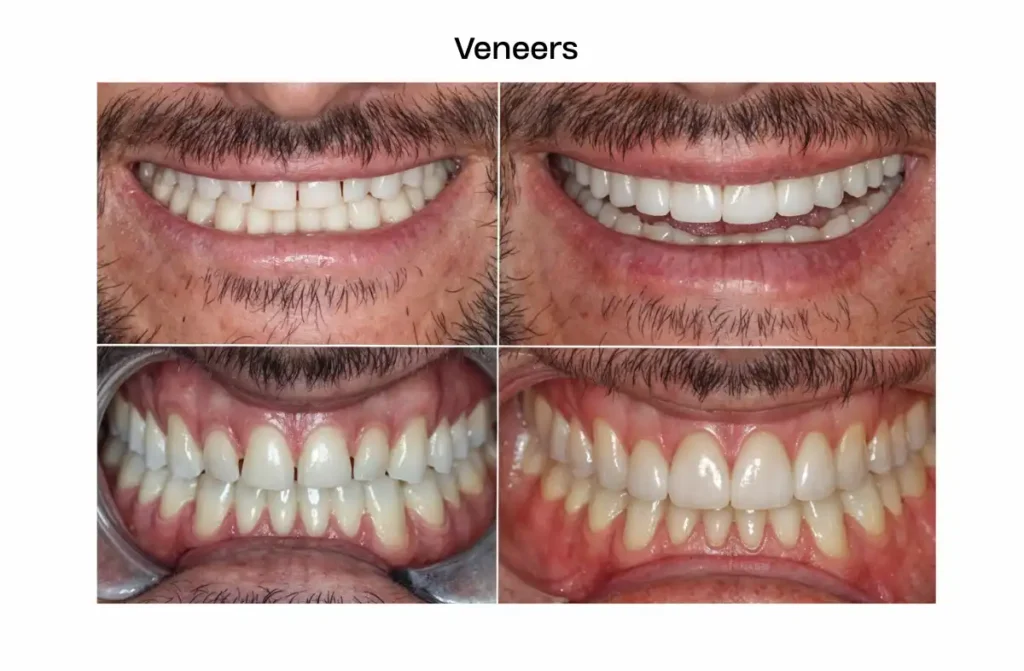
Types of Veneers Treatment in Chennai
Porcelain Veneers in Chennai
Porcelain veneers are fabricated in a dental laboratory from layered ceramic, which is what allows them to mimic the way natural enamel scatters and reflects light. This lab process typically takes several days, which is why porcelain veneers require more than one clinic visit.
Key clinical benefits:
- Aesthetic precision — each veneer is custom-shaded and shaped using a mould of your prepared teeth, so it blends with the teeth around it rather than looking uniformly white
- Stain resistance — the ceramic surface is far less porous than composite, resisting discoloration from coffee, tea, red wine, and tobacco over time
- Longevity — with proper care and regular check-ups, porcelain veneers typically last 10–15 years, sometimes longer
- Structural versatility — corrects chips, gaps, irregular tooth size, and mild rotational misalignment without needing orthodontic treatment first
Patients researching porcelain veneers in Chennai usually choose this route when durability and a completely natural, light-reflective finish matter more than upfront cost, or when several teeth need to be matched precisely for a smile makeover.
Composite Veneers in Chennai
Composite veneers are sculpted directly onto the tooth chairside using a tooth-coloured resin, layered and shaped by hand, then hardened with a curing light. Unlike porcelain, there’s no lab step involved.
Advantages:
- Cost-effective — a more accessible entry point than porcelain, useful for patients treating one or two teeth
- Minimally invasive — often requires little to no enamel removal, since the resin is built up on the tooth surface rather than requiring space for a fabricated shell
- Same-visit results — most cases are completed in a single appointment, start to finish
- Custom shade-matching — blended chairside to your natural tooth colour, with adjustments possible in real time
For patients comparing composite veneers in Chennai against porcelain, composite is typically the right call for smaller corrections, a tighter budget, or a faster result — with the trade-off being a shorter lifespan (5–7 years on average) and a surface more prone to staining and minor chipping.
Porcelain vs. Composite Veneers — Quick Comparison
| Factor | Porcelain | Composite |
| Typical lifespan | 10–15 years | 5–7 years |
| Number of visits | 2–3 (lab fabrication involved) | Usually 1 |
| Stain resistance | High | Moderate |
| Cost | Higher | Lower |
| Repairability | Usually requires replacement | Can often be repaired/touched up chairside |
| Enamel removal | Small amount typically required | Minimal to none |
Cosmetic and Smile Makeover Applications
Cosmetic dental veneers can correct staining, chipping, and minor spacing issues in a single treatment plan, rather than requiring several separate procedures across months. This matters for patients who want a defined endpoint rather than an open-ended series of treatments.
For more complex cases, a full smile makeover uses veneers alongside a broader assessment of facial symmetry, lip line at rest and while smiling, and the proportion of each tooth relative to the others. Rather than treating one tooth at a time, the dentist maps out how the whole arch should look before any preparation begins — which is part of why digital smile previews are useful: they let you see an approximation of the result before committing.
Beyond correction, veneers are also used for aesthetic refinement on teeth that aren’t damaged at all — balancing proportions on a tooth that’s slightly shorter than its neighbours, for instance, or achieving a brightness that resists the fading that whitening treatments are prone to over time, with comparatively minimal removal of the natural tooth.
Veneers vs. Other Cosmetic Options
Veneers aren’t always the right tool for the job. Here’s how they compare to the alternatives patients often ask about:
| Option | Best for | Limitation |
| Teeth whitening | Surface staining, no structural change needed | Doesn’t fix shape, chips, or gaps; results fade over time |
| Composite bonding (not veneers) | Small chips or gaps on one or two teeth | Less durable and stain-resistant than a veneer |
| Veneers | Combined colour + shape correction across visible teeth | Requires some enamel removal (porcelain); irreversible |
| Crowns | Structurally weak or heavily broken teeth | Removes significantly more tooth structure than a veneer |
If your main concern is just shade, whitening is usually tried first. Veneers are typically recommended when whitening won’t solve the problem on its own, or when shape and alignment are also part of the issue.
Cost of Veneers Treatment in Chennai
The cost of veneers treatment in Chennai is not a single fixed number — it depends on several specific factors, and understanding them upfront helps set realistic expectations before your first visit:
- Material chosen — composite is priced lower per tooth than porcelain, reflecting the difference in fabrication and material cost
- Number of teeth treated — a single tooth correction costs less than a full arch smile makeover, but per-tooth pricing may also change slightly with volume
- Case complexity — teeth requiring more shaping, colour correction, or alignment adjustment may involve additional lab or chair time
- Lab quality (porcelain only) — the ceramic material and lab used affect both cost and final aesthetic quality
Because of these variables, exact pricing is confirmed only after a clinical evaluation — tooth condition and the number of veneers required both factor into the final estimate, and quoting a number without seeing your teeth would not be accurate. Book a consultation for a personalised quote specific to your case.

Who is a Good Candidate for Veneers?
Veneers generally suit patients with healthy gums, no active decay, and enough enamel remaining to support bonding. That said, they aren’t automatically the right choice for everyone, and a good clinician should tell you when they aren’t:
- Active gum disease or untreated cavities need to be resolved first — bonding a veneer over an unhealthy tooth or inflamed gum line sets up problems later
- Significant teeth grinding (bruxism) without a night guard puts excess force on veneers and shortens their lifespan considerably, particularly for composite
- Very limited remaining enamel may mean a crown offers more durable, long-term protection than a veneer would
- Teeth needing root canal treatment or with deep structural damage usually need that addressed before any cosmetic step is considered
A short consultation confirms which category applies to you before any treatment plan — porcelain, composite, or an alternative entirely — is proposed.
Risks and Limitations You Should Know
No cosmetic dental procedure is without trade-offs, and being upfront about them is part of informed consent:
- The process is irreversible. Once enamel is removed to prepare a tooth for a veneer, that tooth will need veneer (or crown) coverage going forward.
- Temporary sensitivity to hot and cold is common in the days after preparation and typically settles once the permanent veneer is bonded.
- Veneers can chip or debond, particularly composite, especially with hard foods or grinding — this is manageable but worth knowing about beforehand.
- They don’t prevent decay. The tooth underneath still needs normal brushing, flossing, and check-ups; a veneer only covers the front surface.
The Veneers Treatment Process, Step by Step
- Consultation and smile assessment — discussing your goals, examining tooth and gum condition, and confirming candidacy, often supported by a digital smile preview
- Treatment planning and shade selection — agreeing on the final look, including tooth shape and colour, before any preparation
- Tooth preparation — a thin layer of enamel is removed (minimal for composite, slightly more for porcelain) to create room for the veneer to sit flush
- Impression (porcelain only) — a mould of the prepared teeth is taken and sent to the lab, along with the agreed shade
- Temporary veneers (porcelain only) — worn for a few days while the permanent set is fabricated, so you’re never left without front teeth
- Fitting and bonding — the finished veneer is checked for fit, shade match, and bite before being permanently bonded with dental cement and cured with light
- Final polish and bite check — the surface is polished and the bite is checked to make sure nothing feels high or uneven
- Follow-up review — a short check-in appointment to confirm comfort, fit, and that gums are responding well
Composite veneers generally complete steps 1, 2, 3, 6, and 7 in a single visit. Porcelain veneers typically span two to three visits across one to two weeks to allow for lab fabrication.
What Determines How Long Veneers Actually Last
The commonly quoted “10–15 years” for porcelain and “5–7 years” for composite are averages, not guarantees. In practice, longevity depends on:
- Oral hygiene — consistent brushing and flossing reduces the risk of decay at the veneer margin
- Bite habits — grinding or clenching (especially without a night guard) is one of the most common reasons veneers fail early
- Diet — biting directly into very hard foods (ice, hard candy, unshelled nuts) increases chip risk, particularly for composite
- Follow-up care — regular dental check-ups catch small issues (a lifting edge, minor staining) before they become bigger problems
Common Myths About Veneers
“Veneers ruin your natural teeth.” Some enamel is removed for porcelain veneers, which is why the process is irreversible — but this isn’t the same as damaging the tooth. Done correctly, the underlying tooth remains healthy and functional under the veneer.
“Veneers look fake or overly white.” This was a fairer criticism of older veneer techniques. Modern porcelain is shade-matched and layered to mimic natural translucency; an overly uniform “veneer smile” is usually the result of poor shade planning, not a limitation of the material itself.
“Composite veneers aren’t worth doing since they don’t last as long.” Composite is a legitimate, widely used option — it’s simply a different trade-off (lower cost, faster result, shorter lifespan) rather than an inferior version of porcelain.
Why Choose Dr. Hari’s Dental Centre for Veneers Treatment in Chennai
Dr. Hari’s Dental Centre combines digital smile previews, high-quality porcelain and composite materials, and a minimally invasive preparation technique for every case of veneers treatment in Chennai we take on. Dr. Hariharan. holds a BDS and MDS in Prosthodontics, with clinical experience specifically in restorative and cosmetic case planning — the same discipline that underpins veneer design, shade matching, and long-term bite function.
Patients across the city — and those searching specifically for veneers treatment in Medavakkam — are treated by the same core team from consultation through to final bonding, rather than being passed between providers for different stages of care. You can read more about the clinic’s background on the About Dr. Hari’s page.
What sets the clinic apart:
- Detailed smile assessments with digital previews before any tooth is touched
- High-quality porcelain and composite materials selected for strength and natural finish
- Gentle, minimally invasive preparation technique that preserves as much natural tooth as possible
- Care plans built around your facial structure and bite, not a standard template
- The same clinical team overseeing your case from first consultation to final review
Aftercare Tips for Veneers
- Avoid biting directly into very hard foods (ice, hard candy, unshelled nuts) with veneered teeth
- Use a night guard if you grind or clench your teeth, especially with porcelain veneers
- Maintain regular brushing, flossing, and six-monthly dental check-ups — veneers don’t prevent decay in the tooth underneath
- Limit heavily staining foods and drinks (coffee, tea, red wine), particularly in the first weeks after composite veneers while the surface settles
- Mention any veneer-related discomfort or a “high” feeling in your bite at your next visit rather than waiting for the next scheduled check-up
Conclusion
Whether you’re correcting a chipped tooth, longstanding discoloration, or planning a full smile makeover, veneers offer a conservative, well-established way to achieve a lasting result — provided the case is planned properly and the right material is chosen for your situation. Veneers treatment in Chennai at Dr. Hari’s Dental Centre starts with an honest clinical assessment of whether veneers are the right fit for your teeth, including telling you when they aren’t, rather than defaulting to the most expensive option available. Contact the clinic to book a consultation, or read more about our approach on the About Dr. Hari’s page.


